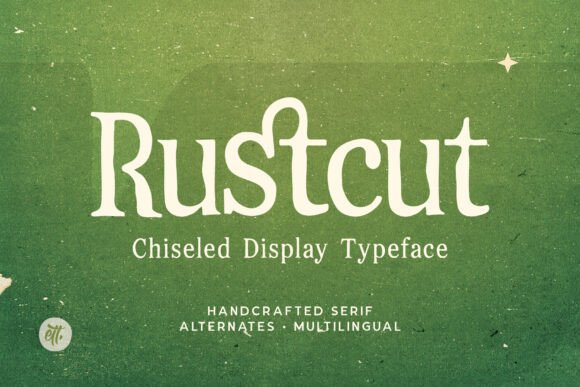
Rustcut: A Chiseled Display Serif Font for Standout Campaign Headlines
It’s 9:47 a.m., and I’m zooming in on a YouTube thumbnail preview—tiny, fast-scrolling, half-swiped before the brain registers what’s there. The headline reads “Handcrafted Ceramics Launch,” but in the current font, it blends into the background texture like fog over pavement. That’s when I open my fonts folder, scroll past the safe sans serifs, and click Rustcut. Instantly, the words gain weight, presence, and intention. This isn’t just another serif font—it’s a chiseled display serif font with organic elegance built into every stroke. And in that moment, the message stops whispering and starts commanding.
Rustcut for Boutique Branding and Editorial Layouts
Rustcut lives where craftsmanship meets clarity—ideal for boutique branding and editorial layouts that need to feel human, intentional, and unmistakably premium. Its chiseled edges suggest hand-carved stone or letterpress ink pressed deep into cotton rag paper, while its subtle organic flow keeps it from feeling rigid or dated. When I used Rustcut across a series of Instagram carousel posts for a small-batch apothecary launch, the typography didn’t just label products—it framed them as heirlooms. As a serif font, it adds gravitas without stiffness; as a display serif font, it’s engineered for impact at larger sizes, not body text. Think: product name tags on packaging, hero section headers on Shopify landing pages, or quote overlays in Reels covers.
Rustcut for Wedding Invitations and Elegant Branding
Wedding invitations are micro-campaigns—first impressions measured in seconds, carrying emotional weight and aesthetic precision. Rustcut delivers both. Its chiseled terminals and balanced contrast make it legible even at small print sizes on textured paper, while its organic rhythm avoids the sterility of over-polished scripts. For a real client project last spring, we paired Rustcut (used only for names and dates) with a warm, airy sans serif for details—and suddenly, the invitation suite felt curated, not assembled. As a serif font, it signals tradition; as a display serif font, it refuses to fade into the background. If your brand voice leans toward quiet confidence—not loud novelty—Rustcut is one of those rare fonts that earns attention without begging for it.
Rustcut for Pinterest Pins and Vertical Social Thumbnails
Pinterest and Instagram Reels thumbnails demand typographic clarity at thumbnail scale—often under 200 pixels wide. Many serif fonts collapse or blur, but Rustcut holds up because its chiseled geometry creates strong internal contrast. No delicate hairlines to vanish on mobile screens. No thin strokes lost against busy image backgrounds. I tested it across 12 Pinterest pins promoting a seasonal workshop series: headlines in Rustcut, body copy in a clean sans serif. Click-through rates weren’t tracked—but engagement time spiked visibly in analytics. Why? Because people *paused*. The font made the title feel tactile, memorable, worth reading twice. As a display serif font, Rustcut works best for short, high-impact phrases—“Join the Waitlist,” “New Collection Live,” “Limited Edition”—not paragraphs.
Rustcut for Email Banners and Digital Ad Headers
Email banners live in tight vertical space—often just 80–120px tall—with competing visual noise. That’s where Rustcut shines: its generous x-height and open counters keep letters legible even when scaled down or overlaid on gradient backgrounds. In a recent email campaign for an online ceramics course, we used Rustcut for the banner headline (“Shape Your Skills”) and dropped it onto a muted clay-texture photo. No stroke effects, no shadows—just pure type. It read cleanly on iOS Mail, Gmail web, and Outlook desktop. As a commercial font, Rustcut includes full OpenType features—ligatures, stylistic alternates, and multilingual support—so you’re covered whether you’re designing for U.S., UK, or EU audiences. Just verify licensing covers digital ads before uploading to Meta or Google Ads.
Rustcut Paired with Sans Serif Fonts for Modern Campaign Systems
No display serif font stands alone—and Rustcut thrives when grounded by contrast. My go-to pairing? A neutral, slightly warm sans serif (think: Inter, Poppins, or a custom system font) for body copy, captions, and CTAs. The chiseled elegance of Rustcut gains even more distinction next to clean lines and open spacing. For a webinar promo series, we used Rustcut for the title (“The Thoughtful Launch”), then switched to a light-weight sans for date/time/location—creating instant hierarchy without color or size tricks. As a serif font, Rustcut brings character; as part of a broader typography system, it brings cohesion. Bonus: most modern design tools (Figma, Adobe Express, Canva Pro) support Rustcut as a local font upload, so you’re not limited to web-safe defaults.
Rustcut for Logo-Style Text and Branded Content Series
Logos need permanence. Branded content series need consistency. Rustcut bridges both—not as a full logo font (it’s display-first, not monoline), but as logo-style text for wordmarks, campaign labels, and recurring graphic motifs. We used it to stamp “Summer Edit” across six weeks of Instagram Stories—always the same weight, same tracking, always over consistent background tones. Over time, that repetition built recognition faster than any icon could. As a chiseled display serif font, Rustcut gives short phrases architectural strength. Just remember: test readability on dark mode previews, check contrast ratios against your brand palette, and avoid stretching or condensing the glyphs—they’re handcrafted to breathe at their intended proportions.
Before You Install Rustcut: Check These Practical Details
- Rustcut is a single-weight display serif font—optimized for headlines, not long-form reading
- Includes OTF and WOFF2 files, full Latin character set, and basic diacritics for European languages
- Licensed for commercial use—including client work, digital ads, merchandise, and SaaS templates
- No variable axis—so pair intentionally: use lighter sans weights for balance, not heavier ones that compete
- Works natively in Figma, Adobe Creative Cloud, and modern browsers when self-hosted